
Is Strength Training Safe for Kids? Everything Parents Should Know
Few topics in youth sports generate as much confusion as strength training.
Many parents have heard conflicting messages:
- “Lifting weights will stunt growth.”
- “Kids shouldn’t strength train until high school.”
- “It’s too dangerous for growing bodies.”
From a sports medicine and youth development perspective, the evidence tells a very different story.
When properly designed and supervised, strength training is not only safe for kids — it is one of the most effective tools for improving injury resilience, movement quality, and long-term athletic development.
What We Mean by “Strength Training” for Kids
One of the biggest misconceptions is that youth strength training means heavy barbells and maximal lifting.
In youth sports, strength training should focus on:
- Learning foundational movement patterns
- Developing body control and coordination
- Gradually introducing resistance in an age-appropriate way
For children and early adolescents, strength gains are driven primarily by improvements in neuromuscular coordination — not increases in muscle size. In other words, kids get stronger by learning how to use their bodies more efficiently.
This distinction is critical when discussing safety.
Is Strength Training Safe for Growing Bodies?
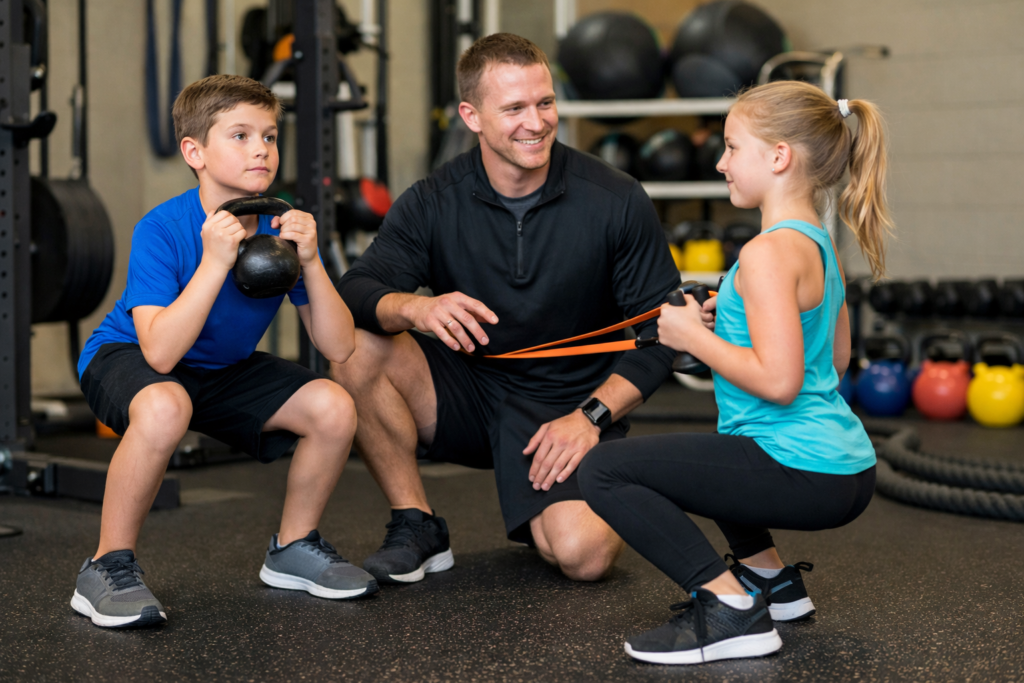
From a sports medicine standpoint, strength training is safe for children when the following conditions are met:
- Exercises are age-appropriate
- Technique is prioritized over load
- Progression is gradual
- Supervision is present
Research consistently shows that properly structured youth resistance training does not stunt growth. Growth plates are vulnerable to injury from excessive or poorly supervised loading, but the same is true in many youth sports that involve jumping, sprinting, or contact.
In fact, the risk of injury is often higher in sport-only environments than in well-supervised strength training settings.
The Role of Strength Training in Injury Prevention
One of the strongest arguments for youth strength training is its role in reducing injury risk.
Strength training improves:
- Joint stability
- Force absorption
- Movement efficiency
- Neuromuscular control
For youth athletes participating in repetitive sports like soccer, basketball, baseball, or volleyball, these improvements help distribute forces more evenly across muscles rather than passive structures such as ligaments and growth plates.
Proper strength training can reduce the risk of overuse injuries by increasing the body’s ability to tolerate training demands safely.
Strength Training and Bone Density in Youth
Childhood and adolescence represent critical periods for bone development. Mechanical loading through resistance training stimulates bone mineral density improvements during these key growth years.
From a long-term health perspective, improving bone density early in life supports skeletal health well into adulthood.
This is one of the most overlooked benefits of youth strength training. When appropriately progressed, resistance training does not harm bone development — it supports it.
Why Movement Quality Matters More Than Weight
Safety in youth strength training is not determined by how much weight is lifted. It is determined by how well movements are performed.
Foundational patterns such as the ones listed below teach young athletes how to control their bodies underload
- Squatting
- Hinging
- Pushing
- Pulling
- Lunging
When movement quality is prioritized, strength training becomes a tool for reinforcing safe mechanics that carry over into sport.
When load is prioritized too early, injury risk increases.
At What Age Can Kids Start Strength Training?
There is no universal “correct” age. Instead, readiness should be determined by:
- Ability to follow instructions
- Emotional maturity
- Coordination level
Many children can begin learning foundational bodyweight movements as early as 7–8 years old in a structured, supervised setting.
The focus at younger ages should be on control, coordination, and consistency — not intensity.
Common Mistakes That Make Strength Training Unsafe
Strength training becomes risky in youth athletes when:
- Athletes train without supervision
- Technique is not corrected
- Programs are copied from adults
- Training volume exceeds recovery capacity
The issue is rarely strength training itself. It is inappropriate programming or lack of guidance.
Strength Training vs. Sport-Only Training
It’s important for parents to understand that youth sports themselves involve high mechanical stress. Sprinting, cutting, jumping, and throwing all load joints and tissues significantly.
When young athletes participate in sport without strength training support, they are often exposed to repeated stress without building the physical capacity to handle it.
In many cases, properly structured strength training actually reduces overall injury risk compared to sport-only participation.
How to Introduce Strength Training Safely
Parents looking to introduce strength training should prioritize:
- Structured progression
- Consistent technique coaching
- Balanced programming
- Recovery awareness
Strength training should complement sport participation, not compete with it.
A consistent warm-up that reinforces movement control is often the best starting point before progressing into a full strength program.
👉 [Access the Free Youth Warm-Up Here]
For families seeking a structured progression beyond a warm-up, a well-designed foundational program can help young athletes build strength safely and confidently.
👉 [Learn More About the Realigned Athletics Foundations Program]
Important Note for Parents
This article is educational in nature and does not replace individualized medical advice. If your child has an existing injury or medical condition, consult a qualified healthcare professional before beginning a strength training program.
Final Perspective
Strength training, when done appropriately, is not something to fear in youth athletes. It is something to understand.
With proper supervision, age-appropriate progression, and a focus on movement quality, strength training can help young athletes:
- Reduce injury risk
- Improve coordination
- Support bone development
- Build confidence
For parents seeking to protect their child’s long-term athletic health, structured strength training is not a shortcut — it is a foundation.