
ANCORE Cable System Review: Is It Worth It for Youth Athletes & Home Gyms?
If you’re looking for a space-saving cable system for a home gym, the ANCORE Cable System probably caught your attention. It’s compact, modular, and marketed as a portable solution for strength training without a full cable machine.
But is it actually useful for youth athletes?
And is it worth the investment compared to larger systems?
As a strength and conditioning coach and Director of Sports Medicine, I’ve programmed cable training for youth athletes, return-to-play athletes, and families training at home. I’ll break down exactly what ANCORE does well, where it falls short, and who it’s truly best for.
What Is the ANCORE Cable System?
ANCORE is a modular, anchored cable trainer designed for small spaces. Instead of a traditional weight stack, it uses interchangeable resistance cartridges that slide into the main unit.
The system attaches to:
- Squat racks
- Wall anchors
- Beams
- Doors (with appropriate attachment)
- Any stable vertical anchor point
This makes it one of the most compact home gym cable systems available.
Unlike larger systems, ANCORE is not a freestanding machine. It depends on a secure anchor point to function properly.
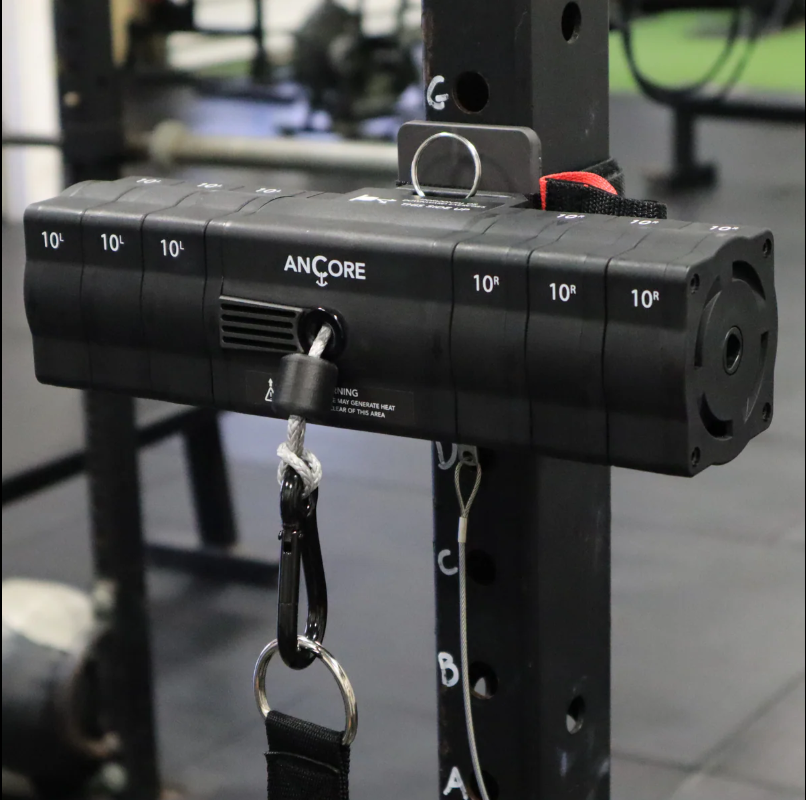
Resistance Levels & Weight Increments
This is where many reviews lack detail.
ANCORE cable system uses interchangeable resistance cartridges. Depending on the configuration you purchase, resistance typically ranges from:
- 5 lbs
- 10 lbs
- 20 lbs
- 30 lbs
- Up to approximately 60–65 lbs total per unit
Resistance increases in cartridge increments rather than digital or dial-based adjustments.
What this means practically:
- You can adjust load in reasonable jumps.
- It’s ideal for movement training, not max strength.
- It encourages controlled, technical reps rather than ego lifting.
For youth athletes — especially ages 10–15 — this range is more than sufficient for:
- Core work
- Rotational training
- Single-leg strength
- Upper-body accessory work
It is not designed for:
- Heavy bilateral squats
- Maximal deadlifts
- Advanced hypertrophy-focused adults
And that’s not a flaw — it’s a design choice.
How ANCORE Cable System Feels During Training
The resistance feels smooth and consistent, similar to a traditional cable stack, but lighter overall.
Because it anchors to a rack or structure:
- You get natural cable angles.
- You can adjust height easily.
- It supports multi-plane movement.
This is extremely valuable for youth athlete development.
In sports, athletes rarely move strictly up and down. ANCORE allows:
- Diagonal patterns
- Anti-rotation drills
- Deceleration training
- Controlled rotational strength
These patterns matter far more than heavy numbers for young athletes.
Best Exercises for Youth Athletes Using ANCORE
Here’s where the ANCORE cable system shines in real programming.
Core & Trunk Stability
- Pallof presses
- Anti-rotation holds
- Rotational chops
- Lift patterns
Lower Body
- Split squat variations
- Single-leg RDL cable pulls
- Lateral resisted lunges
Upper Body
- Single-arm rows
- Half-kneeling presses
- Face pulls
These movements reinforce:
- Postural control
- Hip stability
- Shoulder health
Space Requirements
ANCORE takes up virtually no permanent space.
- The unit itself is small.
- It stores in a drawer or bag.
- It requires only an anchor point.
For families with limited space, this makes it one of the most space-saving cable systems for home gyms.
However, if you do not already have:
- A rack
- A stable beam
- A wall mount
You’ll need to plan for that.
Is ANCORE Safe for Youth Athletes?
Yes — and in many cases, it’s ideal.
Because resistance is capped at moderate levels:
- It discourages overloading.
- It supports controlled movement.
- It reduces risk compared to free weights.
In my experience working with youth athletes, injuries often occur from:
- Poor technique
- Excessive loading too early
- Lack of control
ANCORE naturally guides athletes toward:
- Better control
- Better positioning
- Better progression
Pairing it with a structured warm-up is critical.
👉Free Youth Athlete Warm-Up Program
ANCORE vs MAXPRO: Which Is Better?
This depends entirely on your goal.
| If You Want… | Choose… |
|---|---|
| Full-body strength progression | MAXPRO |
| Portable + higher resistance | MAXPRO |
| Movement quality + core focus | ANCORE |
| Smallest footprint possible | ANCORE |
ANCORE is not meant to replace a full strength system.
It is meant to enhance:
- Movement quality
- Stability
- Athletic positioning
👉 Best Space-Saving Cable Systems for Home Gyms
Who ANCORE Is Best For
ANCORE Cable System is ideal for:
- Youth athletes ages 10–15
- Athletes in rotational sports (baseball, hockey, golf, lacrosse)
- Parents who already own basic dumbbells
- Return-to-play athletes
- Coaches programming movement-focused sessions
Who It’s NOT Ideal For
ANCORE Cable System is not ideal if:
- You want maximal lower-body strength
- You’re training for powerlifting
- You need very high resistance loads
- You don’t have a stable anchor point
This is not a heavy lifting machine. It’s a precision training tool.
Coach Pros & Cons
Pros
- Extremely compact
- Excellent for rotational training
- Encourages control over load
- Ideal for youth development
Cons
- Limited max resistance
- Requires anchor setup
- Not a full gym replacement
Final Coach Recommendation
If your primary goal is helping a youth athlete develop:
- Stability
- Coordination
- Rotational strength
- Long-term movement quality
ANCORE is one of the best compact cable systems available.
It works best as part of a structured training plan — not random workouts.
If you believe ANCORE fits your space and your athlete’s needs, you can check current pricing and configurations below.
👉 View ANCORE Cable System Details Here
(This is an affiliate link. If you choose to purchase, I may earn a small commission at no extra cost to you. I only recommend equipment I’m comfortable programming for youth athletes and families.)